I've had it! And I'm voting for a recall!
This past week, temperatures soared to well over 80 degrees (26 C). Then, we were in danger of getting a freeze! A freeze! All I could think about was the freeze we received on March 27th (26 F, -3 C), that damaged all the buds on my roses.
And don't give me the old wive's tale of never having a freeze after reaching 80 degrees (26c), because we reached 80 before the March 27th freeze.
Instead of enjoying a nice spring flush of beautiful rose blooms, I walk around my garden lamenting the lost blooms. And another freeze was threatening all the newly planted vegetables that have sprung up over the past several days. I was paralyzed, unable to enjoy working outside because I was so worried about the weather.
Would it freeze? Would it not? Would my plants be o.k.? Would I have to start my vegetable garden all over? What was going to happen? All I could do was worry! This year the weather has been up and down like a roller coaster, and I'm tired of the ride!
And I know I'm not the only one.
I've seen the blizzards that are covering the nation. Tornadoes. Hail. Winter that just won't go away.
Like I said, I've had it! I'm voting for a recall on Mother Nature.
Sure, sure, she's a sweet old gal. Brings us butterflies and bees and so many beautiful things.
But she can be nasty, too. And obviously, forgetful. I truly think dementia has set in! Did she forget that spring was supposed to be here already? I rest my case.
I've been thinking about her replacement.
Not Jack Frost.
Santa Claus would not be good, either. I'm afraid he would be too busy at Christmas time to do the job properly.
We've seen what Old Man Winter does when he's in charge! No thanks!
So, I've decided that Father Time would be the best replacement. He's no diva, instead he's hardworking, and he's been around for a long time. He knows how the seasons should flow smoothly into one another.
I bet he would order up fewer droughts! And there would be no more late winters. Think about it - have you ever heard of New Year's being late? No!
Father Time is solid, dependable, and consistent. I think he's a much better candidate for the job.
Are you with me? Do you vote for a recall, too?
Thursday, April 11, 2013
Saturday, April 6, 2013
Still
Still.
I think that is one of the loveliest words in the English language. Not lyrical. It doesn't roll off the tongue in a beautiful way, but the meaning behind it is so very sweet, so romantic, so enduring, so passionate. Songs have been sung, movies have been made about this one little word.
If I were creative, I would compose a song about the early spring blooms that are looking beautiful in my garden...
I think that is one of the loveliest words in the English language. Not lyrical. It doesn't roll off the tongue in a beautiful way, but the meaning behind it is so very sweet, so romantic, so enduring, so passionate. Songs have been sung, movies have been made about this one little word.
![]() |
| hellebore |
If I were creative, I would compose a song about the early spring blooms that are looking beautiful in my garden...
...still.
![]() |
| tulips |
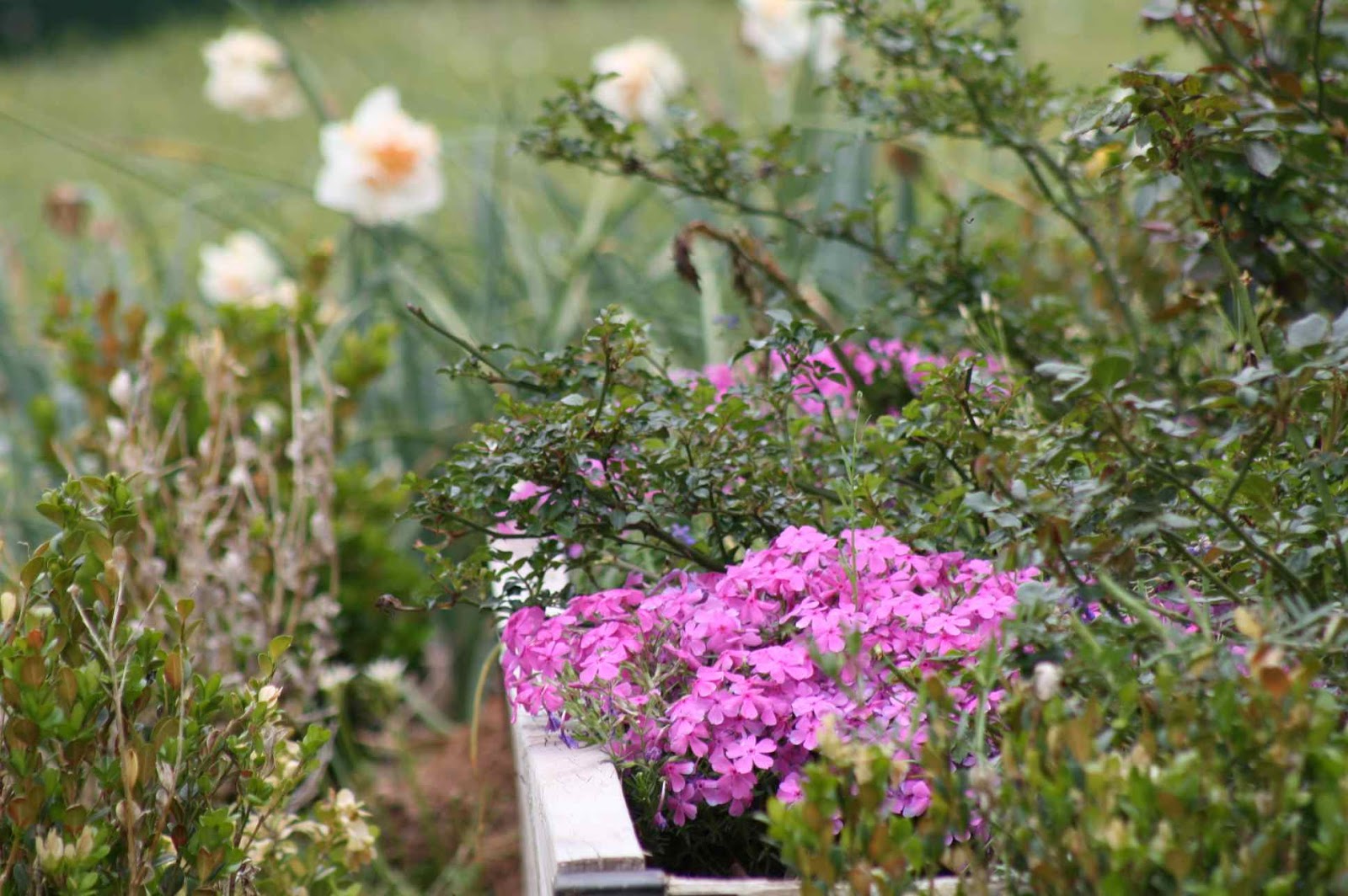
They won't last much longer, but for now, hellebores, pansies, camellias, tulips, phlox, violets, muscari, quince and daffodils are blooming...
![]() |
| phlox, daffodils |
...still.
Even my Christmas cactus is blooming. (Again, not still.)
![]() |
| Christmas cactus |
Usually the weather turns quickly from cold to hot, and spring blooms fade quickly. Not this year. This year, they have continued to bloom, and I have enjoyed their blooms longer than I can remember in years past. In addition to the blooms, daytime temperatures outside have been so very pleasant. Not too hot. Not too cold.
![]() |
| camellia |
Well, we did get a late freeze, which did some damage to tender growth. Usually we worry more about high temperatures. When the temperatures soar, I alway feel as if I'm behind on my chores. This year, I have been working leisurely. I know the temperatures will soon go from pleasant to hot. And I will then feel behind, and rushed.
![]() |
| quince |
And the lovely spring blooms will be gone. I will have different blooms to see then.
![]() |
| irises |
But for now, I'm thrilled to be able to look up from my garden chores and see spring blooms, blooming...
...still.
Friday, April 5, 2013
Veggie Disappointments
No more winter vegetables! I went out of town for a few days and all my broccoli was flowering when I returned. The lettuce has begun to seed. And what about those beautiful Brussels sprouts? After patiently growing Brussels sprouts in my garden, I was so looking forward to preparing and eating them. But, instead, I was shocked and horrified by what I saw:
Mealy cabbage aphids!
Yucky, yucky cabbage aphids on my Brussels sprouts!
These yucky aphids love plants in the cabbage family, and boy, did they ever love my Brussels sprouts!
These are not regular run-of-the-mill aphids. These aphids look larger to me (may be my imagination), and they have a waxy coating that makes they look a bit gray. They can also transmit viruses to other plants.
How to get rid of these aphids? The best form of aphid control is ladybugs. I had a bumper crop of ladybugs in my garden earlier in the year, so I was surprised to see these little buggers on my sweet Brussels sprouts. However, the temperatures had plummeted below freezing a couple of nights before I found the cabbage aphids, so perhaps the temperatures affected the ladybugs.
I have read that you can spray these with water from a high pressure hose to wash them off, but I couldn't get the vision of flying aphids out of my head. Plus, they weren't just on the leaves - they were on the sprouts, too, perhaps even burrowing in the folds of the sprouts (at least, that's what I was imagining), and I didn't want to eat any of them! Yuck! I would rather do without Brussels sprouts than eat one of these ugly buglies! So, that's what I did. Without. I disposed of all of my Brussels sprouts plants.
:(
So, desperate to have some sort of harvest, I began to look at the asparagus. Ah, sweet asparagus!
Alas, that was not to be, either.
When can you harvest asparagus? According to my planting directions, no harvest the first year. Harvest of three or four stalks the second year, and then regular harvesting the third year. This is my second year, so I could harvest a few stalks from each crown (I have three planted). Growing asparagus has been easy, so far, and I was looking forward to bragging about roasting them. My favorite recipe to cook asparagus is just to broil them for a few minutes with a little olive oil, salt and pepper. Yum.
But, remember the freezing nights I wrote about? Well, the tops of the asparagus were killed in the freeze. Bummer. I decided the best thing to do is to wait for more asparagus to emerge and then harvest the few stalks I am allowed this year.
So, no harvest this month! Very disappointing. No harvest from my broccoli. No harvest from my lettuce. No harvest from my Brussels sprouts. And no harvest from my asparagus.
Zero.
Nada.
Nothing.
Zip.
What a blow to my ego! ;)
Even though I had no harvest this month, I joining The Gardening Blog for Garden Bloggers Harvest Day. I hope you had a better harvest for March!
Mealy cabbage aphids!
Yucky, yucky cabbage aphids on my Brussels sprouts!
![]() |
| "Dirt" on the leaves is the first sign |
These yucky aphids love plants in the cabbage family, and boy, did they ever love my Brussels sprouts!
These are not regular run-of-the-mill aphids. These aphids look larger to me (may be my imagination), and they have a waxy coating that makes they look a bit gray. They can also transmit viruses to other plants.
How to get rid of these aphids? The best form of aphid control is ladybugs. I had a bumper crop of ladybugs in my garden earlier in the year, so I was surprised to see these little buggers on my sweet Brussels sprouts. However, the temperatures had plummeted below freezing a couple of nights before I found the cabbage aphids, so perhaps the temperatures affected the ladybugs.
![]() |
| Mealy cabbage aphids! |
I have read that you can spray these with water from a high pressure hose to wash them off, but I couldn't get the vision of flying aphids out of my head. Plus, they weren't just on the leaves - they were on the sprouts, too, perhaps even burrowing in the folds of the sprouts (at least, that's what I was imagining), and I didn't want to eat any of them! Yuck! I would rather do without Brussels sprouts than eat one of these ugly buglies! So, that's what I did. Without. I disposed of all of my Brussels sprouts plants.
:(
So, desperate to have some sort of harvest, I began to look at the asparagus. Ah, sweet asparagus!
![]() |
| Purple asparagus |
Alas, that was not to be, either.
When can you harvest asparagus? According to my planting directions, no harvest the first year. Harvest of three or four stalks the second year, and then regular harvesting the third year. This is my second year, so I could harvest a few stalks from each crown (I have three planted). Growing asparagus has been easy, so far, and I was looking forward to bragging about roasting them. My favorite recipe to cook asparagus is just to broil them for a few minutes with a little olive oil, salt and pepper. Yum.
But, remember the freezing nights I wrote about? Well, the tops of the asparagus were killed in the freeze. Bummer. I decided the best thing to do is to wait for more asparagus to emerge and then harvest the few stalks I am allowed this year.
So, no harvest this month! Very disappointing. No harvest from my broccoli. No harvest from my lettuce. No harvest from my Brussels sprouts. And no harvest from my asparagus.
Zero.
Nada.
Nothing.
Zip.
What a blow to my ego! ;)
Even though I had no harvest this month, I joining The Gardening Blog for Garden Bloggers Harvest Day. I hope you had a better harvest for March!
Monday, April 1, 2013
It's Time!
I've been watching the crossvine.
It's my hummingbird indicator. If it's in bloom, it's time to put out the hummingbird feeders. This year, of course, the blooms were later than usual. Should I put out the hummingbird feeders anyway? I wondered. I hoped the little guys hadn't come through before the crossvine started blooming. I hadn't seen any, but there were reports of hummingbird sightings in Texas. They were beginning to migrate!
Then this past weekend, it happened. My husband came in from the garage and told me I needed to put the hummingbird feeders out - NOW! He had been buzzed by one!
We have cats. We are used to being bossed around by the animals we feed. The hummingbirds are no different. They are a demanding bunch. If there is no food out, they will get out attention somehow to let us know.
It's my hummingbird indicator. If it's in bloom, it's time to put out the hummingbird feeders. This year, of course, the blooms were later than usual. Should I put out the hummingbird feeders anyway? I wondered. I hoped the little guys hadn't come through before the crossvine started blooming. I hadn't seen any, but there were reports of hummingbird sightings in Texas. They were beginning to migrate!
Then this past weekend, it happened. My husband came in from the garage and told me I needed to put the hummingbird feeders out - NOW! He had been buzzed by one!
We have cats. We are used to being bossed around by the animals we feed. The hummingbirds are no different. They are a demanding bunch. If there is no food out, they will get out attention somehow to let us know.
FEED ME!
I might as well be in some play about a carnivorous plant!
As I began to hang up the feeders for our little tyrants guests, I noticed it. The crossvine was just starting to bloom.
Right on time.
If you want to know more about crossvine (Bignonia capreolata), or want to see what this one looks like in full bloom, click HERE.
Saturday, March 30, 2013
Patience Rewarded
I turned into the driveway, and looked toward the house. Suddenly, I stopped the car and took a longer look. Something was different. Something was... beautiful.
The corner bed, aka the winter bed, aka the problem bed looked so nice!
I smiled. Then, I began to analyze.
It must be because of the blooms! The pink crabapples were still blooming, and below them, Carefree Beauty rose was just starting to open up her sweet pink petals. Below Carefree Beauty, pink dianthus was blooming profusely.
And every now and then, I could get a glimpse of the annual cyclamen blooming beyond the boxwoods.
It all came together, looking quite lovely.
But I wasn't convinced that was the reason for my infatuation with this bed.
Was it because I had recently moved a number of plants, and added more to this bed? The plants are so small, they barely peek over the boxwoods. So, I didn't think my transplanting splurge was exactly what held my attention.
All the other plants that are now blooming - the hellebores, the hardy cyclamen, the dianthus I purchased as an annual but has lived for three years now, are also too short to see unless you look over the boxwoods surrounding them. That definitely couldn't be it!
Maybe it was just the fact that I recently mulched this area. Mulching always makes the beds looks so nice.
I found myself drawn to this corner bed. The bench that previously had been only for looks was now being used. Before, I could never rest there. Something else always seemed to grab my attention. But now, I found this area calming, soothing, peaceful.
Still trying to solve the mystery, I chose to get another opinion. I casually remarked to my husband, "The corner bed is looking quite nice this year", and then waited for his response. What he said blew me away.
Well! It wasn't just me, or my imagination! There was something magical about the corner bed!
What was it?
Patience is a lesson gardeners learn over and over. Patience to wait for spring's arrival (I think our patience has been very much tried this year!). Patience to wait for seeds to magically transform into plants. Patience to wait years before the garden matures. It's the last one that many gardeners yearn for. A mature garden seems serene, peaceful, calm. And that was my first clue. The second was that the boxwoods seemed to be key to everything in this bed.
Then I realized - I had waited so many years for the boxwoods to grow into a hedge, and finally they had! Every year before this one, I would see open spaces between the boxwoods. Every year I would anxiously say to myself, "maybe next year". No wonder I could never rest in this area before!
This year, however, there was no separation. The boxwoods had finally matured, growing together to form a perfect frame. It was such a natural occurrence that I hadn't even noticed it immediately. But I had felt it.
Is this part of my garden mature? Of course not. There are many, many years separating this bed from maturity. But, the boxwoods have finally shown me a tiny glimpse of the beauty, peace, and joy of having a mature garden.
That is, if I patiently wait for it.
I'm joining Helen at The Patient Gardener (how appropriate!) for End of Month View.
![]() |
| The Corner Bed |
The corner bed, aka the winter bed, aka the problem bed looked so nice!
I smiled. Then, I began to analyze.
![]() |
| Crabapple blooms |
It must be because of the blooms! The pink crabapples were still blooming, and below them, Carefree Beauty rose was just starting to open up her sweet pink petals. Below Carefree Beauty, pink dianthus was blooming profusely.
![]() |
| Dianthus under Carefree Beauty |
And every now and then, I could get a glimpse of the annual cyclamen blooming beyond the boxwoods.
![]() |
| A glimpse of cyclamen |
It all came together, looking quite lovely.
But I wasn't convinced that was the reason for my infatuation with this bed.
Was it because I had recently moved a number of plants, and added more to this bed? The plants are so small, they barely peek over the boxwoods. So, I didn't think my transplanting splurge was exactly what held my attention.
![]() |
| Looking over the boxwoods is rewarded |
All the other plants that are now blooming - the hellebores, the hardy cyclamen, the dianthus I purchased as an annual but has lived for three years now, are also too short to see unless you look over the boxwoods surrounding them. That definitely couldn't be it!
Maybe it was just the fact that I recently mulched this area. Mulching always makes the beds looks so nice.
I found myself drawn to this corner bed. The bench that previously had been only for looks was now being used. Before, I could never rest there. Something else always seemed to grab my attention. But now, I found this area calming, soothing, peaceful.
Still trying to solve the mystery, I chose to get another opinion. I casually remarked to my husband, "The corner bed is looking quite nice this year", and then waited for his response. What he said blew me away.
"I've noticed it, too."
Well! It wasn't just me, or my imagination! There was something magical about the corner bed!
What was it?
Patience is a lesson gardeners learn over and over. Patience to wait for spring's arrival (I think our patience has been very much tried this year!). Patience to wait for seeds to magically transform into plants. Patience to wait years before the garden matures. It's the last one that many gardeners yearn for. A mature garden seems serene, peaceful, calm. And that was my first clue. The second was that the boxwoods seemed to be key to everything in this bed.
Then I realized - I had waited so many years for the boxwoods to grow into a hedge, and finally they had! Every year before this one, I would see open spaces between the boxwoods. Every year I would anxiously say to myself, "maybe next year". No wonder I could never rest in this area before!
This year, however, there was no separation. The boxwoods had finally matured, growing together to form a perfect frame. It was such a natural occurrence that I hadn't even noticed it immediately. But I had felt it.
Is this part of my garden mature? Of course not. There are many, many years separating this bed from maturity. But, the boxwoods have finally shown me a tiny glimpse of the beauty, peace, and joy of having a mature garden.
That is, if I patiently wait for it.
I'm joining Helen at The Patient Gardener (how appropriate!) for End of Month View.
Wednesday, March 27, 2013
Pretty Purples in a Delayed Spring
Purple reigns in my garden right now:
But as pretty as these beauties are, there's another purple that's caught my eye. Well, actually the combination of purple - with yellow. I posted recently about the combination of my pink creeping phlox and muscari:
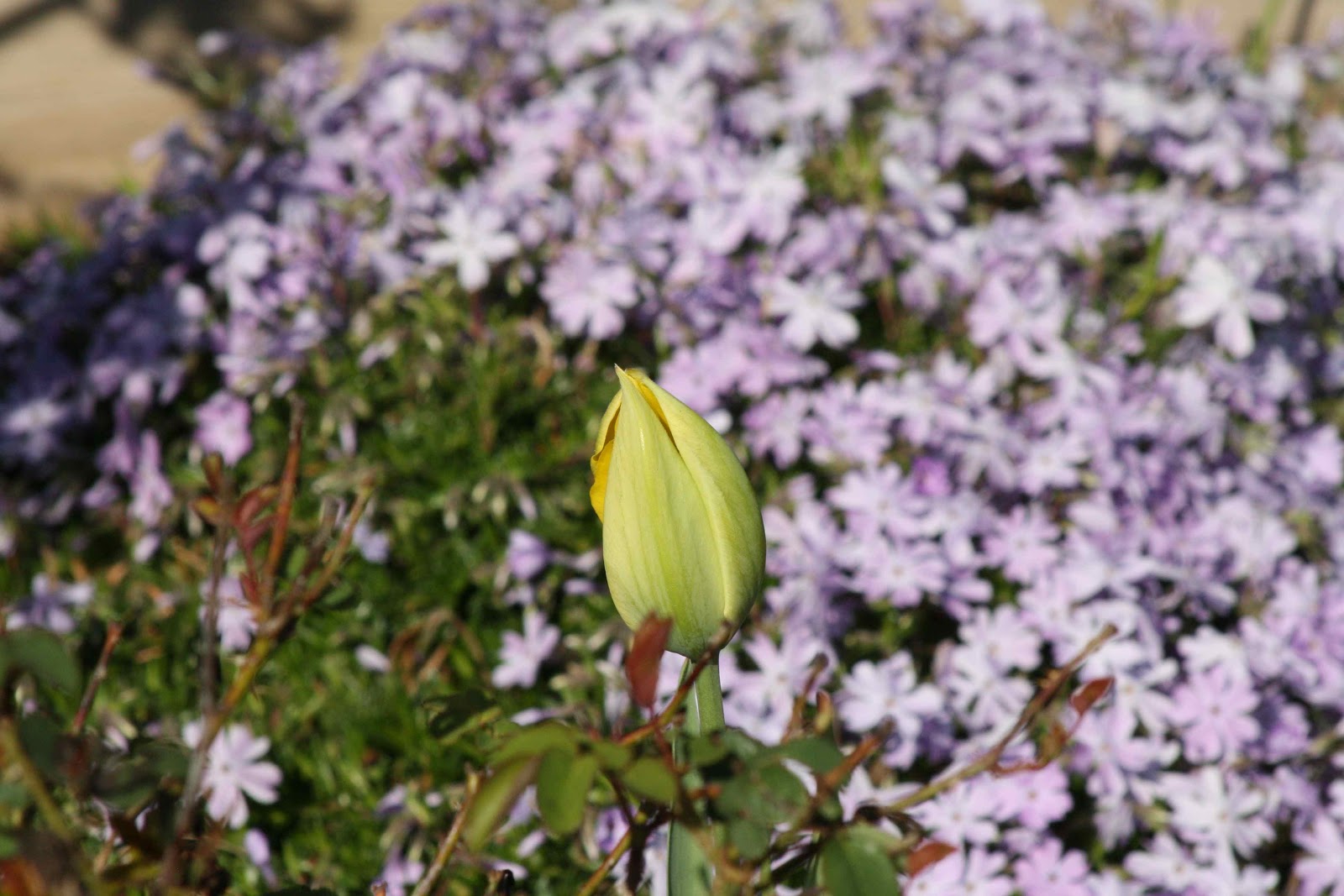
I thought that was just the perfect combination. But, the combination of 'Emerald Blue' creeping phlox with yellow tulips is just as sweet.
Or do you like the combination of purple scabiosa and yellow tulips better?
Are you surprised to see tulips in Texas? I was!
I planted these tulips last year as an annual. It's too hot here for tulips to return well, if at all. And I'm too lazy to dig them up and replant them every year. But surprise! They not only returned, but they are blooming better this year than last! Their return is probably due to being in a raised bed, and the cool days and cold nights we've had lately.
I guess that's one thing I should be thankful for due to our delayed spring!
Monday, March 25, 2013
I Think I'm Happy Now
Mr. Holleygarden thinks I change my garden areas often. I think I change them slowly.
O.k., Here's my argument:
This picture was taken last October. Look at the bottom right. The plant there is pavonia:
This area of my garden has been full of pavonia for several years.
I love pavonia (also called rock rose). It's easy, blooms continually in summer, even in extreme heat. Plus, it's pretty. But, I just never cared for it in this area.
I wanted a red and yellow color scheme in this area, and this was just too much pink. The entire area was pink, and it always looked a bit out of place here. Still, I lived with my garden this way for a while, hoping they would grow on me. But, I knew. I knew the first year they just weren't right.
Don't ask so many questions! You just want me to admit that that's what happens sometimes with impulse purchases!
Anyway, I got a good deal on some variegated liriope, and so I bought them. (Yes, another impulse purchase. I detect a pattern, but I'm not changing my impulse-buying ways!) So, there they sat, waiting to be planted, for several weeks, with me trying to decide where I would put them.
About that same time, I started cleaning up the garden beds.
Yes! Be patient!
As I was saying, I started cleaning up around the pavonia, and decided to thin them out just a bit. But then I thinned them a bit more. And a bit more.
Finally, I just pulled them all out!
Of course not! But, the variegated liriope was just sitting there, waiting patiently to be planted! So, I used it. And I like its bright foliage. And, really, the poor little quince was being suffocated by the pavonia. So it's better this way.
Probably myself, but so far, I really like it. I think that this area now allows the eye to rest, highlighting the roses in the other portion of this bed. I also like the variation in height. So, I'm really liking it, so far.
Well, I do have other things planted in there. Irises, as you can see - I love the foliage even when they're not in bloom. A 'Hot Lips' sage next to the birdbath, cannas (tall red ones in the back and some short yellow ones), some peonies (not sure what kind these are, but for now I'm just happy with the contrast of foliage), 'May Night salvias, a 'Mystic Spires' salvia in the back, and I've ordered some Peacock Orchids (Gladiolus murielae). I think their tall, spiky foliage will make a nice contrast to the floppy foliage of the variegated liriope and the fat foliage of the cannas. So, as the summer progresses, this area will continue to fill in.
So, yes, I'm happy!
For now, at least!
Prove it!
O.k., Here's my argument:
![]() |
| The Walking Garden in October |
This picture was taken last October. Look at the bottom right. The plant there is pavonia:
![]() |
| Pavonia |
This area of my garden has been full of pavonia for several years.
I love pavonia (also called rock rose). It's easy, blooms continually in summer, even in extreme heat. Plus, it's pretty. But, I just never cared for it in this area.
Why not?
I wanted a red and yellow color scheme in this area, and this was just too much pink. The entire area was pink, and it always looked a bit out of place here. Still, I lived with my garden this way for a while, hoping they would grow on me. But, I knew. I knew the first year they just weren't right.
Then why did you buy them?
Don't ask so many questions! You just want me to admit that that's what happens sometimes with impulse purchases!
Anyway, I got a good deal on some variegated liriope, and so I bought them. (Yes, another impulse purchase. I detect a pattern, but I'm not changing my impulse-buying ways!) So, there they sat, waiting to be planted, for several weeks, with me trying to decide where I would put them.
About that same time, I started cleaning up the garden beds.
Is this going to be a long story?
Yes! Be patient!
As I was saying, I started cleaning up around the pavonia, and decided to thin them out just a bit. But then I thinned them a bit more. And a bit more.
Finally, I just pulled them all out!
Obviously, you must have had something planned for this area to pull all the plants out, right?
Of course not! But, the variegated liriope was just sitting there, waiting patiently to be planted! So, I used it. And I like its bright foliage. And, really, the poor little quince was being suffocated by the pavonia. So it's better this way.
Are you trying to convince me, or yourself?
Probably myself, but so far, I really like it. I think that this area now allows the eye to rest, highlighting the roses in the other portion of this bed. I also like the variation in height. So, I'm really liking it, so far.
Really?
Well, I do have other things planted in there. Irises, as you can see - I love the foliage even when they're not in bloom. A 'Hot Lips' sage next to the birdbath, cannas (tall red ones in the back and some short yellow ones), some peonies (not sure what kind these are, but for now I'm just happy with the contrast of foliage), 'May Night salvias, a 'Mystic Spires' salvia in the back, and I've ordered some Peacock Orchids (Gladiolus murielae). I think their tall, spiky foliage will make a nice contrast to the floppy foliage of the variegated liriope and the fat foliage of the cannas. So, as the summer progresses, this area will continue to fill in.
So, yes, I'm happy!
For now, at least!
Oh, brother!
Subscribe to:
Posts (Atom)