Yes, I'm aware that writing in all capital letters is supposedly the equivalent of yelling in the written word. I meant to yell UNCLE! Remember when you were a child, someone would twist your arm or hold you down until you yelled "UNCLE!" It was the equivalent of yelling "I SURRENDER!"
Well, I think my arm has been twisted enough times that I'm on the verge of yelling "UNCLE!" Twisted pulling weeds, that is!
I looked back at my blog posts using the search tool, and every February, March, August and September, I have posted on weeding. Weeds seem to multiply faster than I can pull them. I once read on some forum (can't remember where) that one gardener kept his beds weed free because he weeded every Friday. Without fail, he weeded on Fridays. Of course, if it was raining or freezing, he didn't. But otherwise, he weeded on Friday.
I wondered if I could do that and have a weed free garden, too. So, I gave it a try.
Last Friday, I realized the flaw in this plan. My garden is too big, and my weeds too numerous for me to weed them all out in one day. At least in February, March, August, and September, I need to weed almost every day!
And so, I'm beginning to wonder if I should yell "UNCLE!" to a select number of weeds. Could there really be that much harm?
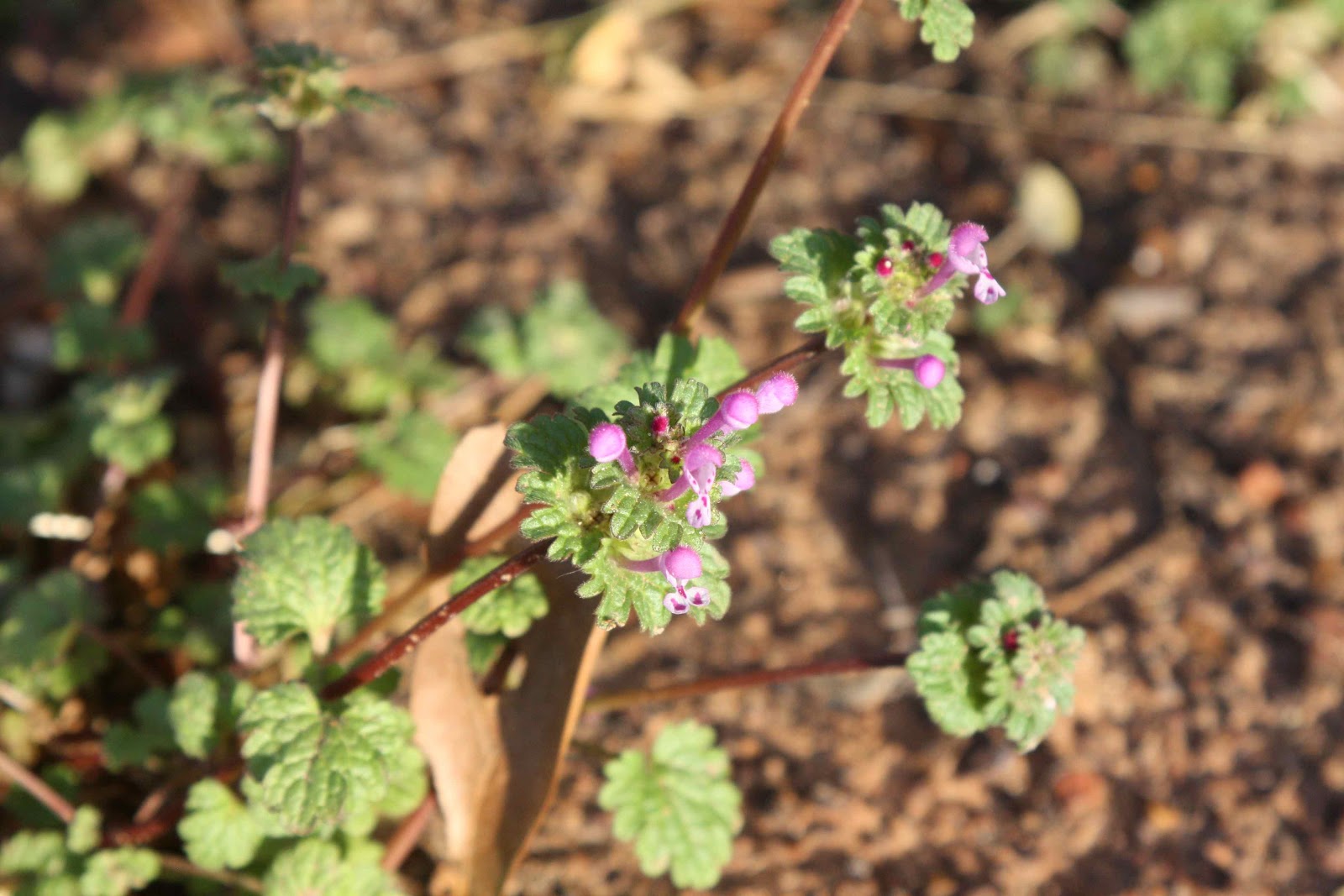
Henbit is one of the prettiest weeds in my garden. I love its sweet little flowers - probably because they're purple. Their lace collars give them a dainty air.
And I love how they will grow in every crack and crevice.
But I know better than to let this weed spread. It would take over the entire garden if left to its own devices, so I try to pull it whenever it invades the flower beds. (The lawn we never weed - a weed-free lawn is not important to us.) So, as much as I like it (and it's edible, too!), I know I must weed it out of my flower beds. I must not surrender.
The false garlic, however, I absolutely hate to see in my garden beds. It pops up everywhere! It's not an easy weed to get rid of, either. Its bulbs are deep, requiring digging instead of pulling. I am tired of my arm being twisted from digging each and every little wild garlic bulb. Plus, they seemingly multiply when my back's turned. I'm considering yelling "UNCLE!" and letting it have its way.
Oxalis is another invasive that I have tried to eradicate from my garden for years. This one I'm still fighting, but as I find more and more, instead of less and less, of this weed in my garden, I'm wondering just how bad it would be if I were to let it run free.
When I first started gardening, I let one weed take over an area in the back. I thought it was pretty, and wondered what harm could come from my letting it take over. Well, I soon learned why this weed was considered a weed. While it had a pretty enough flower, it also had thorns! Ouch! After realizing the error of my ways, I went into full-force battle mode and have almost eradicated it from my garden. So, I know that there is a reason that common weeds are commonly considered weeds.
So, what do you think? Should I let the false garlic stay? How about the oxalis? Have you ever yelled "UNCLE!" to any weed? Did you regret it later?
Sunday, February 17, 2013
Friday, February 15, 2013
This and That for Bloom Day
In our household, we use the phrase "a little bit of this, a little bit of that" to describe a host of situations. It's most effective when used with a slight shrug of the shoulders and a couldn't-care-less attitude.
"What are we having for dinner?"
"A little bit of this, a little bit of that."
"What are you doing today?"
"A little bit of this, a little bit of that."
"Did you buy anything when you went shopping?"
"A little bit of this, a little bit of that."
You see, that little phrase comes in quite handy!
Obviously, my garden has picked up on the habit, because for Garden Bloggers Bloom Day, it has what some may consider winter blooms, and other blooms that are considered spring blooms. In Texas, they all run together - a little bit of this, and a little bit of that. See for yourself:
I rarely show every bloom in my garden, but I felt like they were all working so hard to bloom in February, that they deserved the recognition.
It may just be a little bit of this, and a little bit of that, but there's no shrugging going on here! There's no couldn't-care-less attitude, either. These blooms are telling me:
And that's just what I'm going to do today!
"What are we having for dinner?"
"A little bit of this, a little bit of that."
"What are you doing today?"
"A little bit of this, a little bit of that."
"Did you buy anything when you went shopping?"
"A little bit of this, a little bit of that."
You see, that little phrase comes in quite handy!
Obviously, my garden has picked up on the habit, because for Garden Bloggers Bloom Day, it has what some may consider winter blooms, and other blooms that are considered spring blooms. In Texas, they all run together - a little bit of this, and a little bit of that. See for yourself:
![]() |
| Spring Snowflake (Leucojum vernum) |
![]() |
| Pansy |
![]() |
| Hellebore |
![]() |
| Hardy Cyclamen |
![]() |
| Camellia |
![]() |
| Daffodil (Narcissus) |
![]() |
| Iris (Iris albicans) |
![]() |
| Phlox (Phlox subulata) |
![]() |
| Grape hyacinth (Muscari) |
![]() |
| Rosemary (Rosmarinus officinalis) |
![]() |
| Chinese Fringe Flower (Loropetalum) |
![]() |
| Violets |
![]() |
| Pincushion flower (Scabiosa columbaria) |
![]() |
| Candytuft (Iberis) |
I rarely show every bloom in my garden, but I felt like they were all working so hard to bloom in February, that they deserved the recognition.
It may just be a little bit of this, and a little bit of that, but there's no shrugging going on here! There's no couldn't-care-less attitude, either. These blooms are telling me:
"The garden is waking up! Come on out and play!"
And that's just what I'm going to do today!
Thursday, February 14, 2013
Happy Valentine's Day!
I love Valentine's day. That's because in my area, it's time to prune the roses!
Before I began growing roses, I knew Valentine's day as the day to plant potatoes (and some other vegetables). My father and grandfather would come in late from the fields, having planted all day long. It didn't matter if the day was warm or cold, they planted on Valentine's day.
I'm adding some new vegetable beds to my garden, so I'm going to be a little late planting my vegetables. But I've taken advantage of some of the warm days we've had lately to get a head start on pruning the roses. It's satisfying to study each individual rose and their structure. I feel I get to know my roses better every year because of it. Of course, some of my roses don't get pruned at all, some get pruned only lightly, and some I prune heavily. It depends upon the rose.
Since I know that the roses will start blooming approximately six weeks or so after pruning, Valentine's day indicates to me that it won't be long before my garden is full of blooms again! (The photos above were, of course, taken last year.)
Happy planting and pruning day! When is it time to prune the roses in your area?
Before I began growing roses, I knew Valentine's day as the day to plant potatoes (and some other vegetables). My father and grandfather would come in late from the fields, having planted all day long. It didn't matter if the day was warm or cold, they planted on Valentine's day.
I'm adding some new vegetable beds to my garden, so I'm going to be a little late planting my vegetables. But I've taken advantage of some of the warm days we've had lately to get a head start on pruning the roses. It's satisfying to study each individual rose and their structure. I feel I get to know my roses better every year because of it. Of course, some of my roses don't get pruned at all, some get pruned only lightly, and some I prune heavily. It depends upon the rose.
Since I know that the roses will start blooming approximately six weeks or so after pruning, Valentine's day indicates to me that it won't be long before my garden is full of blooms again! (The photos above were, of course, taken last year.)
Happy planting and pruning day! When is it time to prune the roses in your area?
Tuesday, February 12, 2013
Geometry is Involved
It's raining, and I'm dreaming. Day dreaming. Dreaming of new garden areas, even though the ones I've already started are not finished. I just can't seem to help myself! I've printed out a copy of my house from Google maps, and putting it under a clear plastic sleeve, am drawing new garden areas.
I've always loved math. I guess that's why I've always been drawn to the geometry of formal gardens. Some may think that formal garden design is boring, but to me it's soothing, calming, and relaxing. The lines, the balance, and the patterns bring a sense of order that my mind craves.
Of course, plants know nothing about geometry. I've read that true formal garden design is very difficult to achieve in gardens. The reason is simple. Plant two plants, and one will usually grow taller, fuller, or bloom more than its next door neighbor. Varying degrees of sunlight and soil differences can make a lot of difference, especially when you add in the factor of time.
In my own garden, I prefer formal structure with exuberant plantings. It gives my mind the order it craves, and the abundance of blooms that the gardener inside of me loves. Of course, it's also easier to hide mistakes that way, too. If one plant in a truly formal garden dies, it can spell disaster, especially if the plant is very large.
I've always loved math. I guess that's why I've always been drawn to the geometry of formal gardens. Some may think that formal garden design is boring, but to me it's soothing, calming, and relaxing. The lines, the balance, and the patterns bring a sense of order that my mind craves.
Of course, plants know nothing about geometry. I've read that true formal garden design is very difficult to achieve in gardens. The reason is simple. Plant two plants, and one will usually grow taller, fuller, or bloom more than its next door neighbor. Varying degrees of sunlight and soil differences can make a lot of difference, especially when you add in the factor of time.
In my own garden, I prefer formal structure with exuberant plantings. It gives my mind the order it craves, and the abundance of blooms that the gardener inside of me loves. Of course, it's also easier to hide mistakes that way, too. If one plant in a truly formal garden dies, it can spell disaster, especially if the plant is very large.
Measuring!
Pattern!
Math!
Geometry!
Wahoo!
Drawing new garden plans is always thrilling to me. And day dreaming can be dangerous when you have access to the internet and a credit card!
My head is full of math - and dreams! No better way to spend a rainy day afternoon than in a little gardening geometry!
What about you? Do you like math, too?
Pattern!
Math!
Geometry!
Wahoo!
Drawing new garden plans is always thrilling to me. And day dreaming can be dangerous when you have access to the internet and a credit card!
My head is full of math - and dreams! No better way to spend a rainy day afternoon than in a little gardening geometry!
What about you? Do you like math, too?
Saturday, February 9, 2013
An Innocent Infatuation
I walk outside to see the little blooms that are emerging here and there. An early iris.
A hellebore bloom.
Tiny cyclamen with petals that reach up toward the sky. A few muscari. Daffodils that are not quite blooming, but soon.
I have to look closely for these blooms. None of them are blooming in big enough swatches to make much of an impact, except on my anxious heart. Anxious for spring, I take pleasure in each of their tiny displays of longer days, warmer weather, and the approach of spring.
But I have one plant that is not shy at all. He proudly proclaims his entrance into the coming spring. Waving from afar, his bright red blooms become the center of attention. "Forget those little blooms", he says. "I am the one you've been waiting for."
Like a Prince Charming that rides in on a horse, this plant has swept me off my feet. I almost swoon at the sight of his multi-petaled blooms. His arms are heavy from the weight of all the flowers he bears. Smaller blooms are easily forgotten as I adoringly look his way.
He is bold. His bright red blooms can be seen from across the garden.
He is shy. His boutonniere turns away from me, and blooms turn toward each other, or hide in his leaves.
He normally is a solid, tall, handsome evergreen. He seems content to live in the background of the garden, lost in the shadows. But as winter begins to fade, he morphs into a tender and passionate aficionado of spring. He will arrive to the spring celebration dressed to the nines. Oh, how I love a well-dressed gentleman!
I am infatuated. So infatuated by his captivating charm, I couldn't resist showing him off before his full display of blooms open. I can't wait until he opens up completely to me.
Let me introduce you. This is 'Professor Charles Sargent'. Named for an American botanist, Professor Charles Sargent is a japonica camellia that blooms in late winter or early spring. He will grow to the size of a small tree - around 20 ft, in zones 8 through 10. Like most camellias, he loves to grow in partial shade. But watch out - he will steal your heart!
Which plant infatuates you in spring?
A hellebore bloom.
Tiny cyclamen with petals that reach up toward the sky. A few muscari. Daffodils that are not quite blooming, but soon.
I have to look closely for these blooms. None of them are blooming in big enough swatches to make much of an impact, except on my anxious heart. Anxious for spring, I take pleasure in each of their tiny displays of longer days, warmer weather, and the approach of spring.
![]() |
| Professor Charles Sargent camellia |
But I have one plant that is not shy at all. He proudly proclaims his entrance into the coming spring. Waving from afar, his bright red blooms become the center of attention. "Forget those little blooms", he says. "I am the one you've been waiting for."
Like a Prince Charming that rides in on a horse, this plant has swept me off my feet. I almost swoon at the sight of his multi-petaled blooms. His arms are heavy from the weight of all the flowers he bears. Smaller blooms are easily forgotten as I adoringly look his way.
He is bold. His bright red blooms can be seen from across the garden.
He is shy. His boutonniere turns away from me, and blooms turn toward each other, or hide in his leaves.
He normally is a solid, tall, handsome evergreen. He seems content to live in the background of the garden, lost in the shadows. But as winter begins to fade, he morphs into a tender and passionate aficionado of spring. He will arrive to the spring celebration dressed to the nines. Oh, how I love a well-dressed gentleman!
I am infatuated. So infatuated by his captivating charm, I couldn't resist showing him off before his full display of blooms open. I can't wait until he opens up completely to me.
Let me introduce you. This is 'Professor Charles Sargent'. Named for an American botanist, Professor Charles Sargent is a japonica camellia that blooms in late winter or early spring. He will grow to the size of a small tree - around 20 ft, in zones 8 through 10. Like most camellias, he loves to grow in partial shade. But watch out - he will steal your heart!
Which plant infatuates you in spring?
Thursday, February 7, 2013
Is Common Easier?
Is it easier to grow common plants? You would think so. At least, I always thought so. That is, until I tried to grow azaleas.
Here, azaleas are everywhere. There is even an annual Azalea Festival that showcases these beautiful plants. Every year around the time of the festival, the garden centers here have their azaleas on sale. Every year, I buy some. This year, I'm going to quit doing that. For some reason, every azalea I try to grow, dies.
I have no idea why I can't grow an azalea. They obviously like this climate. It's obvious to me that everyone else can grow them. I have put them in almost every bed in my garden. Lots of sun, lots of shade, and everything in between. I was lamenting the fact that my azaleas always die to another gardener, and he said it was my soil.
I thought about that for a while. No, it can't be. Although some areas where I have had azaleas planted have less than perfect soil, others areas have had beautiful, dark, fertile soil. It doesn't seem to matter where I plant them - they die.
Nor does it matter how much water they seem to get here. Some have been planted in dry areas, some in wet areas, and some in areas that are neither wet nor dry. It makes no difference.
It also doesn't seem to matter what kind of azalea it is, either. I have tried big ones, little ones, even native deciduous ones. They all croak on me.
Different sun, water, type, and soil. I've tried it all. Nothing seems to make a difference. No one understands why my azaleas die. I don't either. Plants do grow here. Plants are happy here! Well, at least, most of them. And the plants that have died, I generally have an idea why. But not azaleas. They are not happy, and I have no clue why they aren't.
So, this year I will quit. I will quit trying to figure it out. I will quit planting more azaleas in the hope that I will figure it out. I will quit buying azaleas. Even the ones on sale. I will quit pinning my hopes on eventually having large bushes bursting with blooms every spring.
It's just not going to happen.
Common implies easier. But sometimes, it just isn't.
Instead of azaleas, maybe I'll try something exotic instead.
(The photos were taken last March. If you want to see more azalea photos like these, click HERE and HERE.)
Do you grow azaleas?
![]() |
| The common azalea - someone else's azaleas |
Here, azaleas are everywhere. There is even an annual Azalea Festival that showcases these beautiful plants. Every year around the time of the festival, the garden centers here have their azaleas on sale. Every year, I buy some. This year, I'm going to quit doing that. For some reason, every azalea I try to grow, dies.
I have no idea why I can't grow an azalea. They obviously like this climate. It's obvious to me that everyone else can grow them. I have put them in almost every bed in my garden. Lots of sun, lots of shade, and everything in between. I was lamenting the fact that my azaleas always die to another gardener, and he said it was my soil.
I thought about that for a while. No, it can't be. Although some areas where I have had azaleas planted have less than perfect soil, others areas have had beautiful, dark, fertile soil. It doesn't seem to matter where I plant them - they die.
Nor does it matter how much water they seem to get here. Some have been planted in dry areas, some in wet areas, and some in areas that are neither wet nor dry. It makes no difference.
It also doesn't seem to matter what kind of azalea it is, either. I have tried big ones, little ones, even native deciduous ones. They all croak on me.
![]() |
| Again - these are not my azaleas |
Different sun, water, type, and soil. I've tried it all. Nothing seems to make a difference. No one understands why my azaleas die. I don't either. Plants do grow here. Plants are happy here! Well, at least, most of them. And the plants that have died, I generally have an idea why. But not azaleas. They are not happy, and I have no clue why they aren't.
So, this year I will quit. I will quit trying to figure it out. I will quit planting more azaleas in the hope that I will figure it out. I will quit buying azaleas. Even the ones on sale. I will quit pinning my hopes on eventually having large bushes bursting with blooms every spring.
It's just not going to happen.
![]() |
| These aren't mine, either |
Common implies easier. But sometimes, it just isn't.
Instead of azaleas, maybe I'll try something exotic instead.
(The photos were taken last March. If you want to see more azalea photos like these, click HERE and HERE.)
Do you grow azaleas?
Tuesday, February 5, 2013
Not Just Lettuce Anymore!
I am used to my garden giving me little surprises. A new bloom here, an emerging bulb there. In the garden, I am never sure what will be different, but I do know that things will be different.
My vegetable bed, however, has never surprised me much. In December, I harvested lettuce. In January, I harvested lettuce. It's now February, and guess what? I'm harvesting lettuce!
Again.
I've had so much lettuce, it even grows in the cracks along with the weeds!
So, I wasn't surprised about the lettuce. But the vegetable bed did decide to surprise me this month!
Not quite ready to harvest, but growing nicely, are some broccoli. I don't have many plants planted, but the ones that are there have decided that it's time to get to work. With temperatures over 70 degrees (21C), they need to hurry up or they will be bolting soon!
Also growing nicely are the Brussels sprouts. Mmm mmm, how I love Brussels sprouts! They, too, are not quite ready to harvest - but soon!
I have read to cut the leaves off below the sprouts so the energy will go into making the sprouts instead of into the leaves, and I do plan on doing this. I want my sprouts to be successful - I'm already licking my lips just thinking about how delicious they will be!
The green peas have also decided to give me a surprise. They were planted last autumn. They bloomed, and then were frozen by a December cold front. Although they didn't die, I thought they would be a failure.
But these little sweeties are persistent. They have decided to bloom again! Maybe green peas will be in my future after all!
Yum, yum! I'm looking forward to harvesting something next month besides lettuce!
I'm joining The Gardening Blog for Garden Bloggers Harvest Day.
My vegetable bed, however, has never surprised me much. In December, I harvested lettuce. In January, I harvested lettuce. It's now February, and guess what? I'm harvesting lettuce!
Again.
I've had so much lettuce, it even grows in the cracks along with the weeds!
So, I wasn't surprised about the lettuce. But the vegetable bed did decide to surprise me this month!
Not quite ready to harvest, but growing nicely, are some broccoli. I don't have many plants planted, but the ones that are there have decided that it's time to get to work. With temperatures over 70 degrees (21C), they need to hurry up or they will be bolting soon!
Also growing nicely are the Brussels sprouts. Mmm mmm, how I love Brussels sprouts! They, too, are not quite ready to harvest - but soon!
I have read to cut the leaves off below the sprouts so the energy will go into making the sprouts instead of into the leaves, and I do plan on doing this. I want my sprouts to be successful - I'm already licking my lips just thinking about how delicious they will be!
The green peas have also decided to give me a surprise. They were planted last autumn. They bloomed, and then were frozen by a December cold front. Although they didn't die, I thought they would be a failure.
But these little sweeties are persistent. They have decided to bloom again! Maybe green peas will be in my future after all!
Yum, yum! I'm looking forward to harvesting something next month besides lettuce!
I'm joining The Gardening Blog for Garden Bloggers Harvest Day.
Subscribe to:
Posts (Atom)


