Monday, April 1, 2013

It's Time!

I've been watching the crossvine.


It's my hummingbird indicator.  If it's in bloom, it's time to put out the hummingbird feeders.  This year, of course, the blooms were later than usual.  Should I put out the hummingbird feeders anyway?  I wondered.  I hoped the little guys hadn't come through before the crossvine started blooming.  I hadn't seen any, but there were reports of hummingbird sightings in Texas.  They were beginning to migrate!

Then this past weekend, it happened.  My husband came in from the garage and told me I needed to put the hummingbird feeders out - NOW!  He had been buzzed by one!

We have cats.  We are used to being bossed around by the animals we feed.  The hummingbirds are no different.  They are a demanding bunch.  If there is no food out, they will get out attention somehow to let us know.

FEED ME!

I might as well be in some play about a carnivorous plant!


As I began to hang up the feeders for our little tyrants guests, I noticed it.  The crossvine was just starting to bloom.


Right on time.


If you want to know more about crossvine (Bignonia capreolata), or want to see what this one looks like in full bloom, click HERE.

Saturday, March 30, 2013

Patience Rewarded

I turned into the driveway, and looked toward the house.  Suddenly, I stopped the car and took a longer look.  Something was different.  Something was... beautiful.

The Corner Bed

The corner bed, aka the winter bed, aka the problem bed looked so nice!

I smiled.  Then, I began to analyze.

Crabapple blooms

It must be because of the blooms!  The pink crabapples were still blooming, and below them, Carefree Beauty rose was just starting to open up her sweet pink petals.  Below Carefree Beauty, pink dianthus was blooming profusely.

Dianthus under Carefree Beauty

And every now and then, I could get a glimpse of the annual cyclamen blooming beyond the boxwoods.

A glimpse of cyclamen

It all came together, looking quite lovely.

But I wasn't convinced that was the reason for my infatuation with this bed.

Was it because I had recently moved a number of plants, and added more to this bed?  The plants are so small, they barely peek over the boxwoods.  So, I didn't think my transplanting splurge was exactly what held my attention.

Looking over the boxwoods is rewarded

All the other plants that are now blooming - the hellebores, the hardy cyclamen, the dianthus I purchased as an annual but has lived for three years now, are also too short to see unless you look over the boxwoods surrounding them.  That definitely couldn't be it!

Maybe it was just the fact that I recently mulched this area.  Mulching always makes the beds looks so nice.

I found myself drawn to this corner bed.  The bench that previously had been only for looks was now being used.  Before, I could never rest there.  Something else always seemed to grab my attention.  But now, I found this area calming, soothing, peaceful.

Still trying to solve the mystery, I chose to get another opinion.  I casually remarked to my husband, "The corner bed is looking quite nice this year", and then waited for his response.  What he said blew me away.

"I've noticed it, too."

Well!  It wasn't just me, or my imagination!  There was something magical about the corner bed!

What was it?


Patience is a lesson gardeners learn over and over.  Patience to wait for spring's arrival (I think our patience has been very much tried this year!).  Patience to wait for seeds to magically transform into plants.  Patience to wait years before the garden matures.  It's the last one that many gardeners yearn for.  A mature garden seems serene, peaceful, calm.  And that was my first clue.  The second was that the boxwoods seemed to be key to everything in this bed.


Then I realized - I had waited so many years for the boxwoods to grow into a hedge, and finally they had!  Every year before this one, I would see open spaces between the boxwoods.  Every year I would anxiously say to myself, "maybe next year".  No wonder I could never rest in this area before!


This year, however, there was no separation.  The boxwoods had finally matured, growing together to form a perfect frame.  It was such a natural occurrence that I hadn't even noticed it immediately.  But I had felt it.


Is this part of my garden mature?  Of course not.  There are many, many years separating this bed from maturity.  But, the boxwoods have finally shown me a tiny glimpse of the beauty, peace, and joy of having a mature garden.

That is, if I patiently wait for it.

I'm joining Helen at The Patient Gardener (how appropriate!) for End of Month View.


Wednesday, March 27, 2013

Pretty Purples in a Delayed Spring

Purple reigns in my garden right now:


But as pretty as these beauties are, there's another purple that's caught my eye.  Well, actually the combination of purple - with yellow.  I posted recently about the combination of my pink creeping phlox and muscari:


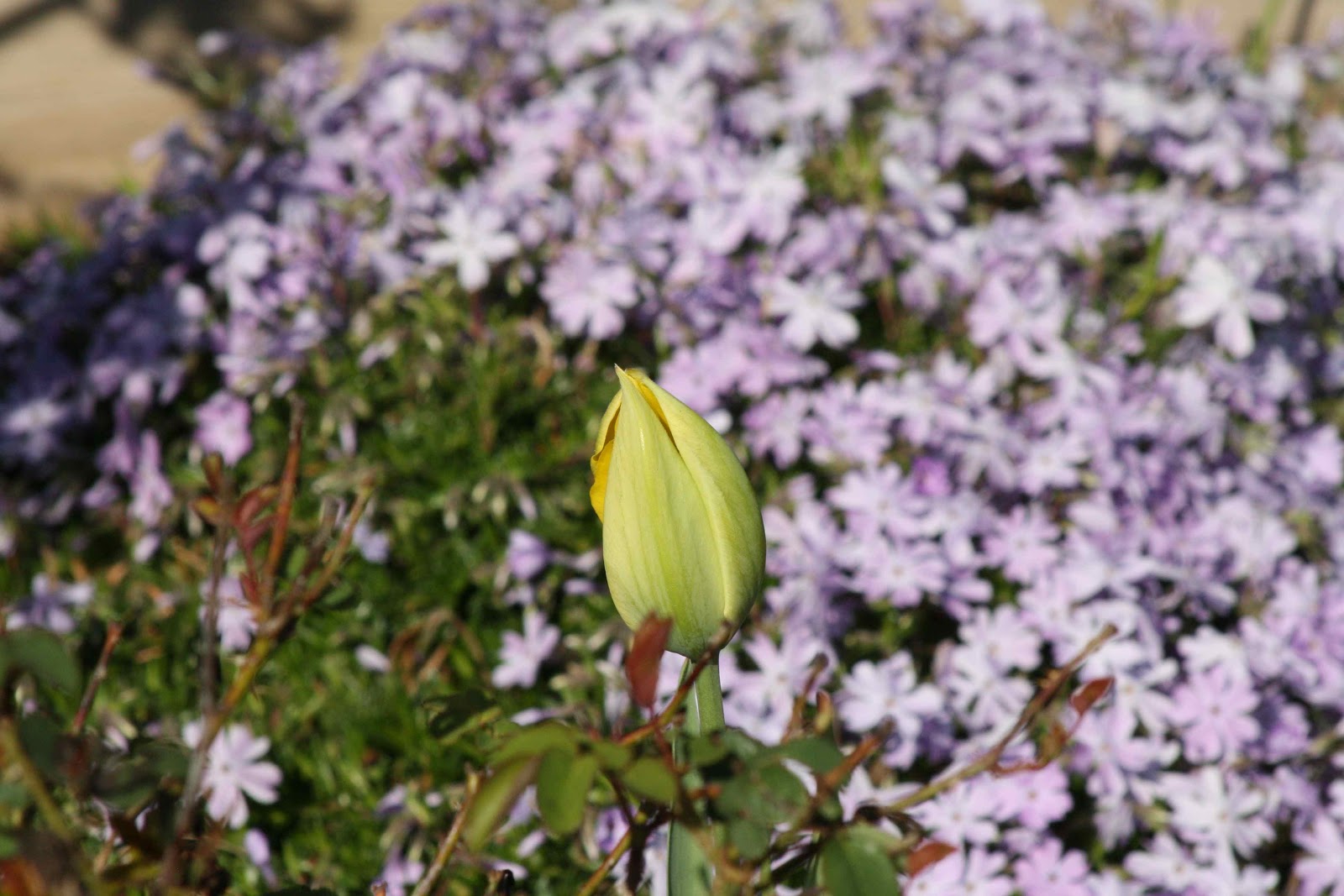
I thought that was just the perfect combination.  But, the combination of 'Emerald Blue' creeping phlox with yellow tulips is just as sweet.


Or do you like the combination of purple scabiosa and yellow tulips better?


Are you surprised to see tulips in Texas?  I was!

I planted these tulips last year as an annual.  It's too hot here for tulips to return well, if at all.  And I'm too lazy to dig them up and replant them every year.  But surprise!  They not only returned, but they are blooming better this year than last!  Their return is probably due to being in a raised bed, and the cool days and cold nights we've had lately.


I guess that's one thing I should be thankful for due to our delayed spring!


Monday, March 25, 2013

I Think I'm Happy Now

Mr. Holleygarden thinks I change my garden areas often.  I think I change them slowly.

Prove it!

O.k., Here's my argument:

The Walking Garden in October

This picture was taken last October.  Look at the bottom right.  The plant there is pavonia:

Pavonia

This area of my garden has been full of pavonia for several years.

I love pavonia (also called rock rose).  It's easy, blooms continually in summer, even in extreme heat.  Plus, it's pretty.  But, I just never cared for it in this area.

Why not?

I wanted a red and yellow color scheme in this area, and this was just too much pink.  The entire area was pink, and it always looked a bit out of place here. Still, I lived with my garden this way for a while, hoping they would grow on me.  But, I knew.  I knew the first year they just weren't right.

Then why did you buy them?

Don't ask so many questions!  You just want me to admit that that's what happens sometimes with impulse purchases!

Anyway, I got a good deal on some variegated liriope, and so I bought them.  (Yes, another impulse purchase.  I detect a pattern, but I'm not changing my impulse-buying ways!)  So, there they sat, waiting to be planted, for several weeks, with me trying to decide where I would put them.

About that same time, I started cleaning up the garden beds.

Is this going to be a long story?

Yes!  Be patient!

As I was saying, I started cleaning up around the pavonia, and decided to thin them out just a bit.  But then I thinned them a bit more.  And a bit more.

Finally, I just pulled them all out!

Obviously, you must have had something planned for this area to pull all the plants out, right?

Of course not!  But, the variegated liriope was just sitting there, waiting patiently to be planted!  So, I used it.  And I like its bright foliage.  And, really, the poor little quince was being suffocated by the pavonia.  So it's better this way.

Are you trying to convince me, or yourself?

Probably myself, but so far, I really like it.  I think that this area now allows the eye to rest, highlighting the roses in the other portion of this bed.  I also like the variation in height.  So, I'm really liking it, so far.


Really?

Well, I do have other things planted in there.  Irises, as you can see - I love the foliage even when they're not in bloom.  A 'Hot Lips' sage next to the birdbath, cannas (tall red ones in the back and some short yellow ones), some peonies (not sure what kind these are, but for now I'm just happy with the contrast of foliage), 'May Night salvias, a 'Mystic Spires' salvia in the back, and I've ordered some Peacock Orchids (Gladiolus murielae).  I think their tall, spiky foliage will make a nice contrast to the floppy foliage of the variegated liriope and the fat foliage of the cannas.  So, as the summer progresses, this area will continue to fill in.


So, yes, I'm happy!

For now, at least!

Oh, brother!


Saturday, March 23, 2013

Ring! Ring!

When I was younger, my sister and I would race to answer the ringing telephone.  No cell phones back then!  There were several rules regarding telephone usage.  The first person that reached the phone got to answer it.  But we never answered it until the second ring.  We had to answer it "R's residence."  (R being our last name.)  The telephone was mounted on a wall in the kitchen.  It had an extra long cord from the telephone to the receiver, and we stretched it out to talk on the phone and sit at the dining room table.

All conversations were monitored by our parents.  Who was calling.  What they wanted.  And, of course, our side of the conversation was overheard.

Ah, the good old days before texting!

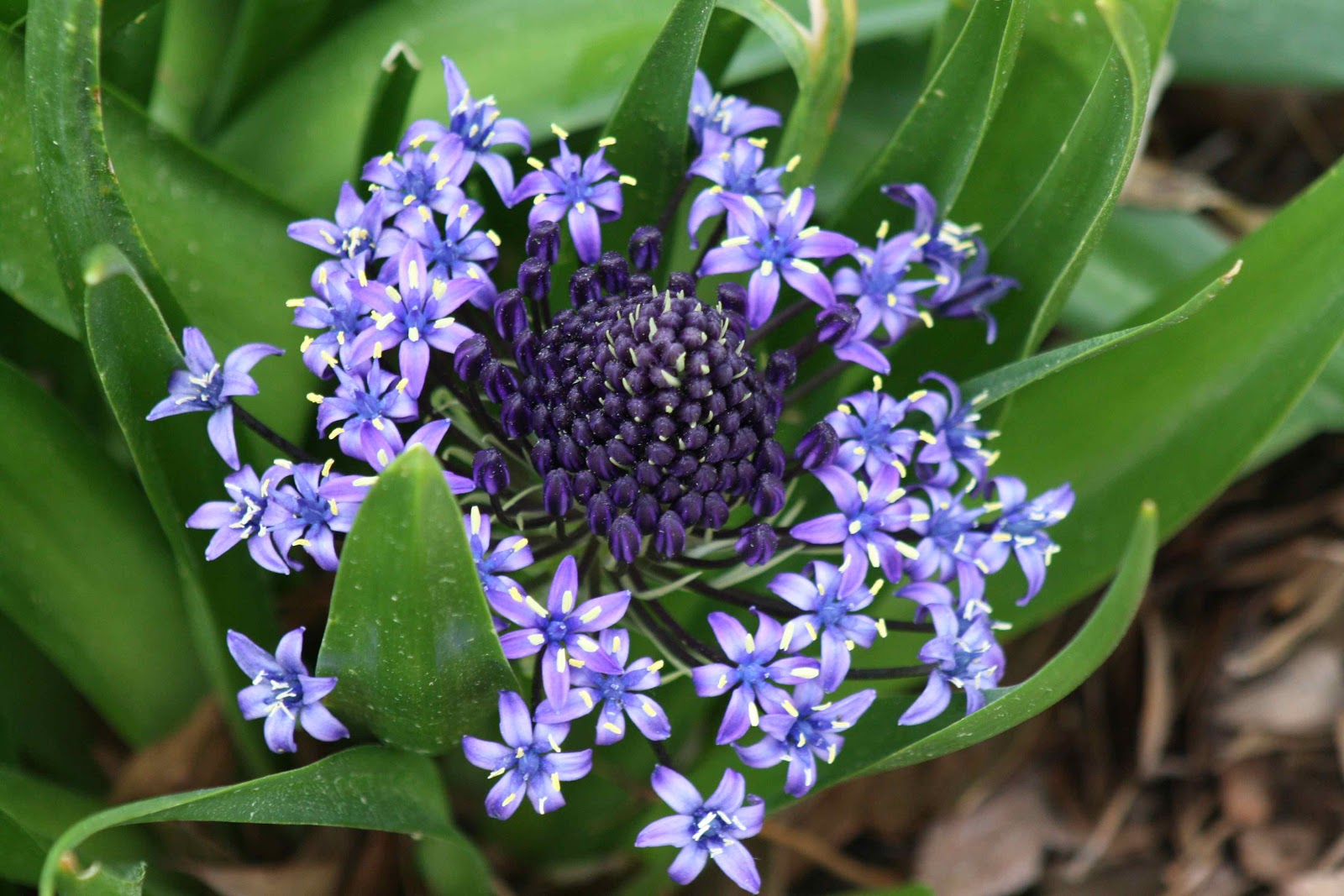
I now race to a different ring.  A ring of blooms.  Every morning, I race outside to see the Peruvian scilla that is blooming in my garden.  Every day is a new discovery.  Every day there are more blooms in the ring.  Just look!

Day 1:


Day 2:


Day 3:


I wonder how many rings of blooms tomorrow will bring!  And how many days it will take for the blooms to reach the top!


Portuguese squill, Peruvian scilla, or scilla peruviana is hardy from zones 7 through 10.  This is the first time it has bloomed since I planted it, three springs ago.  I read that it hates being transplanted, and takes a while to bloom afterwards.  I hope it is finally happy, and that it blooms again next year.

If it does, I'll be racing to see those gorgeous rings!

Thursday, March 21, 2013

New Blooms and A New Goal

The reason I love roses so is because of their long bloom time.  In my garden, they bloom from March through November.  In fact, the first rose has begun to bloom.  This year, Carefree Beauty:

Carefree Beauty

and Sweet Drift:

Sweet Drift

tied for first bloom of the year.

It took me a long time to appreciate blooms that only last for a few days or weeks.  I wanted every plant to bloom as long as my roses!  But I have slowly begun to appreciate the short season of blooms from other plants.  A garden where every plant is in bloom every season is just not feasible!

I now love seeing the different blooms as the seasons change, and how that changes my garden.  For instance, this phlox that's blooming along with the muscari is, in my opinion, perfect.


The muscari would be nice on its own, and the phlox would be nice on its own, too.  But together, they make this area a masterpiece of beauty for a small amount of time.


Seeing this area has given me a new goal:  To make each area of my garden perfectly beautiful - no matter how short that time may last.

I'm joining Tootsie Time for Fertilizer Friday.


Tuesday, March 19, 2013

Garden Book Reviews March 2013

When does a book become a classic?  I'm not sure, but I have a couple of classic gardening books to recommend this month.  Both are for rose lovers.


The first book, In Search of Lost Roses by Thomas Christopher is a small book that is full of many tales, all of them about roses.  The large Lady Banks rose in Arizona, rose rustling in Texas, Josephine's planting style at Malmaison, identification of Chinese roses, the wanderings of Robert Fortune, the "Mother Lode" of roses in California, and a private garden of 8,500 rose bushes sold because of a tax increase, are just a few of the tales told.

Even with so many tales in one book, the writing flows easily.  Dick Streeper states that it is "masterful storytelling", and that describes it perfectly.  If you love roses, you will find yourself unable to put this book down.

It is a classic.


Another classic book for rose lovers is How to Pronounce French Rose Names by Diana Bellucci.  The title states it all.  If you want to ask for a rose without stating "I'm not sure how to pronounce it, but it might be Du-sure or Dew-shay", then you can look it up and know that it's the latter.

Want to pronounce the rose Souvenir de Gilbert Nabonnand correctly?  Just look it up, and you will find that it is pronounced as soo-vneer duh zheel-behr nah-bo-na(n).  German roses are also listed, so you can pronounce Pink Frau Karl Druschki as fraow kahrl DROOSH-kee.  Even those of us with a southern drawl can feel confident knowing that we are pronouncing our rose names correctly!


(The rose photos are from last November.)  

Now it's your turn!  Please join us every 20th of the month with your own garden book review.  Any book with a gardening influence qualifies.

Related Posts Plugin for WordPress, Blogger...