Thursday, October 18, 2012

Warning!

Warning! Warning, Will Robinson!

Do you remember the robot from 'Lost in Space'?  These warnings were accompanied by the robot waving its arms, the lights on its head blinking, and its body moving back and forth.

Well, I am warning you!  My arms are waving, my head is shaking, and my body is jumping up and down.  Warning! Warning!

What am I warning you about?  A rose.

Mutabilis

A rose?

Yes, a pretty rose.  A very pretty rose.  A rose by a sweet name - the Butterfly Rose.  That name just doesn't seem to impart danger.  But I'm here to tell you the truth.  And to warn you.

The Butterfly Rose is the nickname of the rose 'Mutabilis'.  Those sweet little blooms look a bit like butterflies all over it.  When I planted Mutabilis in the middle of a corner in my garden, my sister laughed.  Laughed!

"Where's the rest of the plantings?", she asked.

"That one rose will grow to take up the entire corner."  One look at her and I knew she doubted me.  "Really!"

I knew.  Or, at least I thought I knew.  I knew Mutabilis got to 10 ft. tall at maturity.  I knew it would grow to fill in the entire 8 ft. corner.


What I didn't know was that Mutabilis would grow from around 5 ft. tall last year to almost 9 ft. tall this year - only its fourth year!  I didn't know that instead of just filling in the corner, it would outgrow it!  I'm thinking 10 ft. tall is a small estimate of its mature size, and 8 ft. wide doesn't even come close.

I really don't care how tall this rose gets.  The sky is the limit - literally.  But width is another matter.  It covers the sidewalk, and no one can pass by.  I have cut it back twice this year already and I'm sadly realizing I am going to have to keep trimming on it to keep it within the bounds of its corner.  Not what I had planned at all.

No room to walk on this sidewalk!

Last year I waxed poetic about Mutabilis.  I even wrote, "I have it in a corner where it can grow as large as it wishes."  Ha!  This year I know - Mutabilis is an uncontrollable monster in disguise!

 For reference: the fence (far left) is over 6 ft. tall here!

I still recommend this rose.  It's an easy care rose to grow.  But now I'm adding a warning:
Grow Mutabilis at your own risk.  It needs a large area.  
A very large area.

You have been warned.


Wednesday, October 17, 2012

Thank Goodness for Chemicals!

I have been spraying myself down with chemicals every day.  Oh, I wouldn't go without it!

Yes, you are right - I have tried very hard to not use chemicals in my garden.  I admit to the rare use of a chemical fertilizer or herbicide.  But those are rare, not occasional, instances.  And I have been rewarded.


Rewarded with butterflies.  Rewarded with bees.  Rewarded with all sorts of strange and wonderful creatures that I don't think I would have ever seen otherwise.


I am especially excited to see the toads in my garden.  I haven't seen toads since I was a child.  When we first moved here, we could hear them down past the big pond, singing and talking every night.  It was as if they were carrying on several conversations, and each toad would talk louder and louder, trying to talk over the other toads' conversation.

But my neighbor sprays his pasture, and the conversations stop.  All goes silent.


Lately, however, we have been hearing the toads talking again.  My neighbor has moved, and while he still owns the property, he has not been doing any spraying.

I have been thrilled to see toads coming all the way up to the house!  They are such a surprise and a joy to see.


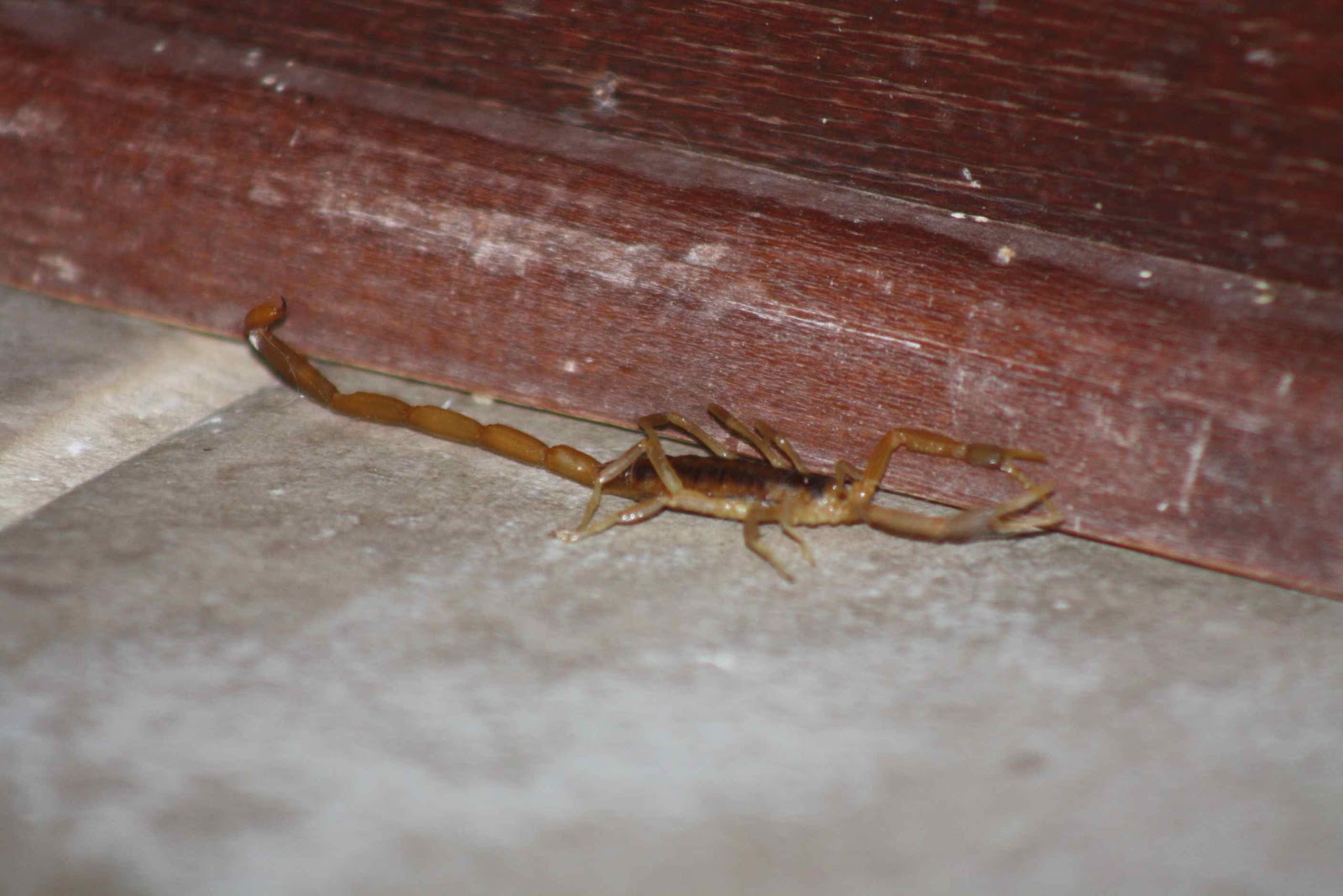
Not every creature is a joy, though.  We have been seeing scorpions - in our house!  I don't know where they are coming from, as I don't see them out in the garden.  But this summer alone, we have killed over 10 scorpions in the house.  Thankfully, we have not been stung.

My husband has asked me if I want him to spray for the scorpions.  But I think of the toads, and I say "not yet".


But there is one creature I have begun using chemical warfare against.

That creature is the mosquito.

It started with the six inches of rain we received.  And ever since then, we have been swarmed with mosquitoes.  I have walked around the property, emptying any pan or container that could hold water.  I have drilled holes in the fountain we not longer use (it's broken, but I like it anyway).  Pet bowls get refreshed regularly.  I don't know where these mosquitoes are coming from, but they are relentless.

Since there have been over 4,000 cases of West Nile this year, with 1/3 of those cases from Texas, a mosquito bite has deadly potential.  In fact, we have discussed how odd the mosquito bites are this year.  They make large whelps on our skin with just one bite, and I have wondered if a little bit of the virus is in every mosquito.

So, every day I go out into my mostly organic garden, and spray myself down with deet.


I try to eat organic vegetables.  We eat very little meat.  I try very hard to have a very creature-friendly garden, no matter the creature.  And yet I spray a chemical on myself every day!  It seems a bit bizarre to me.  And yet, oddly, I'm thankful that I can spray myself and go outside.

Scorpions may not make me cross the line into chemical warfare.  But tiny little mosquitoes do!

What about you?  What would you like to eradicate, through any means, from your garden?


Tuesday, October 16, 2012

If Momma Ain't Happy, Ain't Nobody Happy

For years I have wondered if David Austin was happy.  Successful?  Definitely.  Handsome?  Clearly.  Cordial?  Surely.  Commanding?  Probably.  But happy?  I wondered.

That saying "If momma ain't happy, ain't nobody happy" kept running through my head.  Basically, it means that if the woman of the household isn't happy, then she will (either obviously or covertly) make the other family members miserable.  I wondered if David Austin was miserable.

Why?

Well, because of Pat.  Pat Austin is David Austin's wife.  Pat Austin is also a rose.  A rose bred by David Austin and named for his wife.

Pat Austin

Naming a rose after your wife would surely make for some moments of marital bliss!  Still, I wondered.

I know absolutely nothing of Pat Austin, the person, except for that one simple fact.  She is David Austin's wife.  But, I wonder if there are clues in the description of her rose on the David Austin website:

  • Short climber (actually, in my garden, she's still a short bush)
  • Strong fragrance
  • Bright color
  • Tea-scented with a warm sensuous background
  • Deeply cupped flowers (I'll let your imagination run with this!)  ;)
She grows in zones 5 through 10.


Her description sounds lovely.  But for years she wasn't very lovely in my garden.  Maybe it's just American soil, or the fact that mine is own-root, but in my garden, and in some others I have heard about, she has been a source of complaint.  

And with such a poor rose named after her, I wondered if she was happy with this particular rose bearing her name.  And if she wasn't happy....  well, you know the saying!


But I shouldn't have doubted.  I should have trusted.  David Austin surely knew what he was doing.  He wouldn't have named a poor performing rose after his wife!  And, he didn't.  Because now that Pat Austin (the rose) has finally grown to maturity, she is outstanding.  Yes, her blooms still nod (maybe hinting at a trait of shyness?), but they now nod on stems that are strong.  Years ago their blooms dropped face-first into the mud.  But now she is the delight of my garden.  She is utterly charming.


She has a unique but beautiful color.  An orange, but not a neon orange.  Copper is the word used to describe it.  And it's a good word.  Like copper, sometimes her patina has a slightly pink undertone.  Sometimes the undertones are more yellow, and yet she mixes well with other soft-colored roses.  I think in real life, she must be a gracious hostess.

I am so glad I didn't get rid of Pat Austin prematurely.  She is a rose that needs a bit of time to fulfill your expectations.  She can't be rushed.  She must be nurtured, pampered, and attended.  But treating her gently will reward you greatly. 
 
bush shot

I now know that David Austin must be a happy man.  I now understand why he would name this rose after his wife.  It is a remarkable rose, if you will only give it a bit of time.  She will never be the star of the garden.  She doesn't stand out.  Yet, she is a gentle and lovely addition.  Her softness is her strength.  She has that one particular quality that is uniquely rare and underrated: she elevates the garden with her presence.  


Yes, I'd say momma is happy.  Well done, Mr. Austin.

Monday, October 15, 2012

Autumn Arrives in the Winter Garden

My garden is a summer garden.  Full sun in most areas, with roses thrown in anywhere space allows.  Summer fades slowly here.  The roses bloom well into October, possibly November, and some years even December!  I hate to see summer end.  But there is one area that makes me want to welcome autumn with open arms.

Do you remember last year when I decided to turn the boxwood garden into my winter garden?  Well, recently I was asked by a visitor why I hadn't mentioned the winter garden lately on my blog.

Uh, because it's not winter?

Honestly, the answer is because I've not paid it any attention.  I was busy this summer with other areas of my garden, and this part of the garden was completely ignored.

But lately, the winter garden has been on my mind.  After all, autumn has arrived, hasn't it?  It's hard to tell here.  I'm still wearing shorts and the temperatures still get up to 80 degrees during the day, but that's 20 degrees lower than our summertime highs, so I suppose it's as close to autumn around here as we get.

James Galway

James Galway is planted next to the winter garden, and he is at his best during our autumns.  Everyone that stops by remarks about how pretty this rose is.  And he really is quite handsome!  (And he smells great, too.)  They don't even glance at the winter garden.


But, if only they would look past James, visitors would see that there really are a number of things going on in the winter garden.

Three camellias planted in this garden (a 'finlandia variegated', a 'green's blue', and a new one planted just this year, 'autumn pink icicle') are loaded with buds.  No blooms, but a gardener doesn't need blooms to get excited.  Buds are exciting enough.

Of course, this bed has had its share of problems.  Earlier in the year, I killed a camellia (not enough water), and a cimicifuga (too much water) that was new and tiny.  Can you tell I had problems with the sprinkler system in this area?  I've replaced the cimicifuga, and am hoping I do better with this new one.  (I put it in a different spot.)

Another reason this bed is often overlooked is because most of the plants in this bed are young.  I try to tell myself that this is a garden hidden with a lot of little treasures to discover.  In reality, I'll be thrilled when the larger plants have matured enough to peek over the top of the boxwoods.

Two plants that are large enough to see are the roses that are planted here.  Souvenir de St. Anne's is planted next to James Galway, and she is looking very pretty right now.


This picture doesn't do her justice.  She is really a very delicate pink.

Souvenir de St. Anne's

Do you see the spider on her?  The spider has turned pink, too!

Carefree Beauty

Carefree Beauty is also blooming in this bed now.


And the abelia has been blooming most of the summer.  I am hoping next year will be the year it grows taller than the boxwood hedges surrounding it.


A clematis carries through the dark pink color scheme.


And if you look close enough, you will find another dark pink treasure - cyclamens.  Although these are newly planted, and an annual here, I'm hoping they are located in a position sheltered enough to make it through our winters.

I have a lot of hope for this bed.  As the days grow shorter, and the shadows grow longer, I find myself naturally drawn more and more to this area.  Perhaps it's the shade, perhaps it's the evergreens, perhaps it's the purple chrysanthemums I added to this area.  Perhaps it's just my imagination, but to me, it has the feel of autumn.  It's calmer, softer, more subdued.

In the rest of my garden, summer is no distant memory.  The roses are still blooming.  The lantana are still attracting butterflies.  Even the canna are performing as if it's July instead of October.

But autumn has arrived.  At least, autumn has arrived in the winter garden.

I'm joining Carol at May Dreams Gardens for Garden Bloggers Boom Day.


Friday, October 12, 2012

The Presidential Gardens Tour

I was thrilled.  The airline didn't bump me.  The flight was on time (early, actually).  And my luggage was not lost.

And when I looked down from the plane's window, I loved what I saw: green, green, and more green.  There were green trees everywhere.  It was just beautiful.  And while it was too early for a full fall foliage display, I didn't care.  I was going on a Presidential Gardens Tour!

In the end, I was pleased to visit three gardens of previous Presidents.  Can you guess where I was?

Charlottesville, VA is home to Monticello, Thomas Jefferson's famed home.  James Monroe's home, Ashland-Highland is just 2-1/2 miles away from Monticello.  And in Orange, VA, outside of Charlottesville, sits James Madison's home, Montpelier.

Just a little advice: Do NOT type in Montpelier into your gps tracking device, or google maps, expecting them to know it as a point of interest.  Both of them will take you to the town of Montpelier, VA, an hour away from your intended destination.  Unfortunately, I learned that the hard way.

And if you are planning your own Presidential Gardens Tour, George Washington's Mount Vernon is just a few hour's drive from Charlottesville (near Alexandria, VA).  But due to time constraints and complications with traffic congestion, my plans to visit it were spoiled.

I'll just have to plan another trip!

Here are just a few of my vacation pictures from Monticello, Ashlawn-Highland, and Montpelier.  We'll start with the home of the third President of the United States, Thomas Jefferson's Monticello:

Monticello from the back.

See that pathway in the picture above?  This was a circular pathway lined with flowers on both sides.  I could imagine walking along this path every morning, and maybe I'll be able to incorporate this design somewhere in my own garden.


This is just one of the groups of flowers lining the pathways.  So many different varieties of flowers all placed together!  And the plantings were different in each grouping.  In addition, they were planted very densely.  So, while not everything in the groupings were blooming at the same time, it had the feel that the entire group was blooming because they were planted so closely together.

But I was most impressed with the vegetable garden:

So different from my weed-filled vegetable garden!  Some things had just been planted.  Their little leaves were just beginning to pop up through the soil.  And some things were ready to be harvested.  I felt quite inadequate as a vegetable gardener here!


Above is another area of the vegetable garden.  There were a few pods, but most of these peas were in flower.  Morning glories and other climbing flowers were planted along with them.  It was just beautiful.


Instead of taking the shuttle bus down the hill, we walked.  About halfway down is the graveyard.  I loved this unusual headstone, and think it looks especially lovely with the lush plantings around it.

&&&&&&&&&&&

Just around the corner is the home of the fifth President of the United States, James Monroe's Ashlawn-Highland:

Ashlawn-Highland from the back.
Ashlawn-Highland was a small house, but the grounds were beautiful.  The approach to the house was lined with ash trees.  Oh, how I wish I had a winding road leading to my home.  I would love to have it lined with trees like this.  Simply gorgeous.


They also had a beautiful vegetable garden (shown below), and a small kitchen garden with numerous herbs and a fig tree right outside the kitchen doorway.  I am determined to have a much less weedy vegetable garden next year!  I especially loved how they had beautiful ornamental plantings outside the vegetable garden.  There was even a climbing rose bowing over the picket fence.   You know I found that charming!


According to our guide, the tree below was over 300 years old!  This wasn't the only tree that commanded attention.  There were several areas where large and beautiful trees were featured.  Note to self: plant more trees!


Check out the free-range chicken in the background of the picture below!  haha - The rooster was trying so very hard to keep his "girls" in line, but they seemed to be ignoring him!  In addition to chickens, there are also peacocks that wander the grounds.


While this garden was smaller than Monticello's, it had a uniquely enjoyable personality.  

&&&&&&&&&&&

Home to the fourth President of the United States, James Madison's Montpelier (in Orange, VA!) was the final home we visited.

Montpelier from the back.
The Annie duPont Formal Garden was lovely (the duPont family owned Montpelier for many years).  It doesn't look large when you first step into this garden, but as you begin to find little areas tucked away, it begins to dawn on you just how large this garden actually is!


This above view is just one small area looking across the garden.  A hedge lined most of the straight walk through the middle of the garden, but wander around, and you will realize that there is much more about this garden than just what you can see from the main path.  Hidden on either side are lovely plantings, several benches, secret pathways, and even a rustic bridge.

It was fun discovering these little secret areas.  See the bench in the picture below?


Besides this particular garden, there was much more to discover here, including hands-on demonstrations, and a forested walk.


Next to the house are the model slave quarters (above).  Before going to Virginia, I read 'Founding Gardeners', the book reviewed by Dorothy of Soil Sister of the San Joaquin.  I am so thankful that Dorothy brought this book to my attention.  It made the founding fathers come to life for me, and I noticed things in these gardens that my eye would not have caught before.  These slave quarters are just one of the many things discussed in the book.


This temple located on the grounds is also discussed in the book.  It sits over a well which was used as an ice house, keeping the temple cool, and allowing them to serve iced drinks and even ice cream during the summer - a rare treat back then!

A close up of the plantings at Ashlawn-Highland.

Each of the gardens were uniquely wonderful.  Famous and beautiful, you could see the love of gardening that Thomas Jefferson had at Monticello.  James Monroe's Ashlawn-Highland had gorgeous views and lovely garden areas.  And James Madison's Montpelier was quite impressive with its numerous trees and rolling hills.  I recommend touring all three!

Have you had the opportunity to tour these gardens?


Tuesday, October 2, 2012

Fringe Benefits

Do you like fringe?

Hanging strands of pure decoration can delight, enhance, and add personality.  It does the same for plants.  I've noticed I have three plants with fringe all planted in the same bed!  I love these little extra touches of decoration.

Chinese indigo

Chinese indigo (indigofera decora) has the most elaborate fringe.  Very frilly.  Quite orate.  This would make a beautiful pendant.  And the delights don't stop at the fringe.  Look at those purple stems!  A beautiful pendant of small pink pearls hanging by a purple cord.  Quite stylish!  I wish I had one of these in my jewelry box.  Read more about this plant here.


Loropetalum

Loropetalum is appropriately nicknamed fringe flower.  Its little strands of fringe hang down casually, almost wildly.  What do you see?  I see the fringe of a circus horse.  The ringmaster holds on to it by a braided leather reign that is secure, but not tight.  Its fringe bounces up and down, delighting children and impressing adults.  Read a little more about this plant here.


Caryopteris

Caryopteris has fringe that sticks up, instead of hanging down.  This is the fringe of a ballerina's tutu.  She turns pirouettes as the audience holds its breath.  She is so beautiful, so enchanting, the subject of many artists.  But a picture or a photo can never quite capture her radiance.  After the show is over, her performance will be remembered fondly, and with a touch of awe.  It will seem like a dream until her show starts again the next autumn.

I love the fringe in my garden.  It awakens my imagination, and brings such delight.  The same can be said about vacations.  One of the fringe benefits of having sisters is that they sometimes invite you to vacation with them.  I will be gone on one of these vacations for about a week.  When I return, I will have stories to tell, photos to show, and experiences to recall.

Until then, I hope you find some delights in your own garden, and a plant or two showing off their fringe.


Monday, October 1, 2012

Norman

The Weather Channel had a brief explanation.  Too brief, I thought.  But then again, I had just switched to that channel when I heard them talking about it, so perhaps I missed some of the coverage.

I had just begun to brace for a warm, dry autumn and winter.  The jet stream, it was said, was going across the United States quite a bit north of Texas, blocking cold fronts from traveling down to us, and thus, thwarting any rain chances that we had.  The prediction was for this to continue, and I have been concerned about another drought starting in autumn like the drought we experienced in 2011.

Then Norman came along.  Norman was what The Weather Channel was explaining when I casually clicked to that channel, looking for the day's radar.  Norman was different.  Norman was unexpected.  Norman was, well, not normal.


You see, here in east Texas, we watch for hurricanes or tropical depressions forming in the Atlantic Ocean.  If these tropical depressions travel into the Gulf of Mexico, we have a pretty good chance of getting rain here.

But Norman was different.  Norman was coming from the Pacific.  Norman was traveling over Mexico toward Texas.  And, Norman was south of the jet stream (the same jet stream that was blocking the rain from the north), so the rains coming from Norman were staying in the South.  It would move across Texas, Louisiana, and other Southern states, slowing moving eastward and northerly.  It was also bringing rain.  Lots of rain.


Over the past two days, Norman dropped over 6 inches of rain on my garden.  I am so pleased.  My plants are looking perky.  It had been dry, and I had gone back to watering.  There was flooding in some areas, and I hope no one was adversely affected.  Here, rain was very much appreciated.  Six inches was thrilling!

Maybe the rest of the winter will be dry.  But for now, I'm thankful for Norman.

The remnants of (what was) Norman are traveling eastward.  Were you, or will you be, affected?
Related Posts Plugin for WordPress, Blogger...